
Bull leaping

A short excerpt from Pasiphaë. An encounter with the tragedy that was always so close, and that would eventually spill over into a flood.
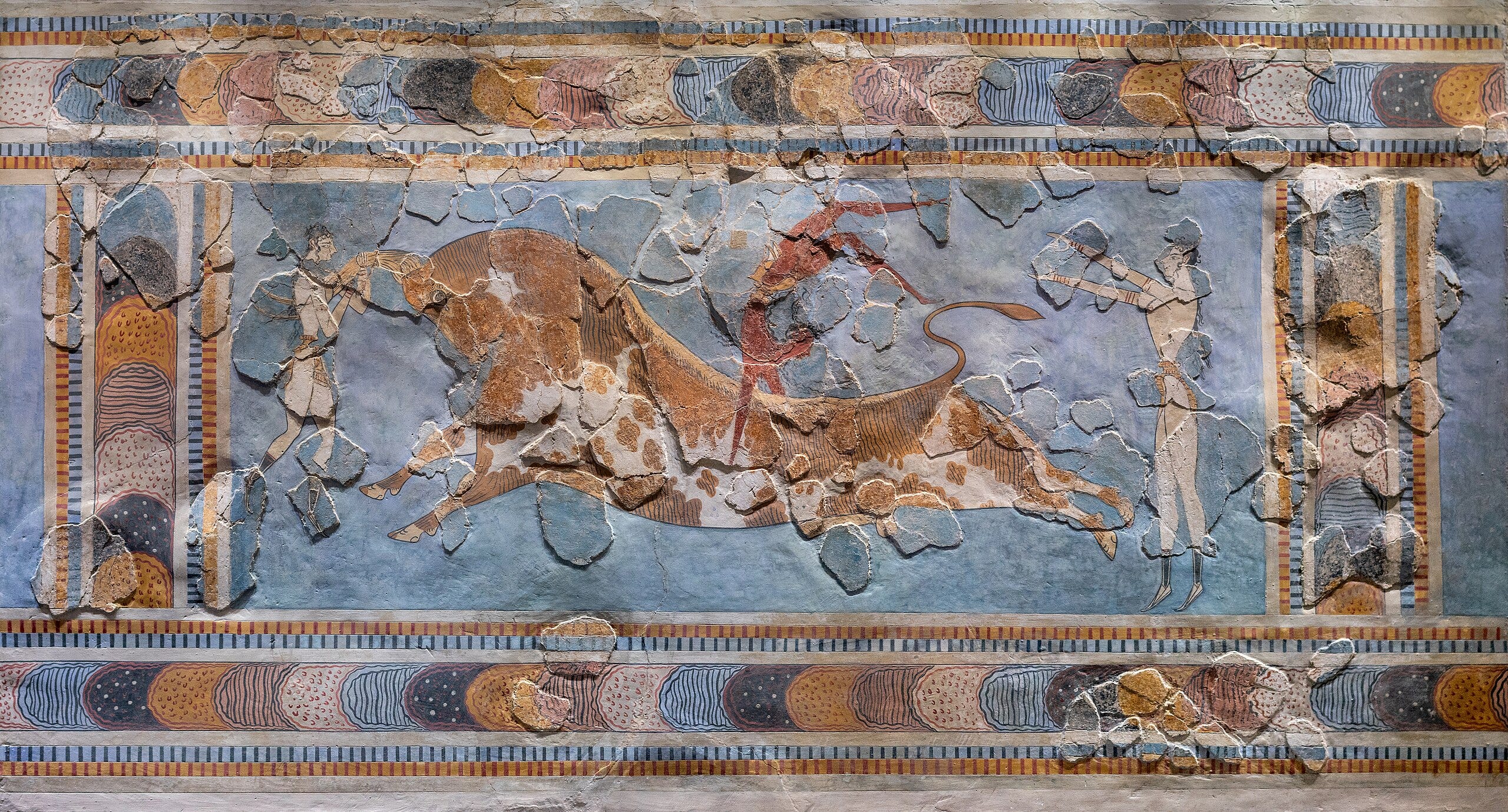
The first days became first weeks, and the rites that required Pasiphaë’s presence dwindled to a trickle. At Aea, there had just been one shrine dedicated to Potnia Theron, and her mother and Circe officiated at all the other rituals. There had never been much to do. She had expected that at Knossos, as High Priestess of the Mistresses, she would be called upon every day for a ritual at one of the many shrines within the palace, and as Queen, to sit in judgement as Perseis and Circe did. There were entertainments, acrobats and feasting, and once, to celebrate the successful wheat harvest, there was bull-leaping. It would be on the tip of her tongue to ask Asterius why there were so few visitors to the shrines, why, though there were countless rooms dedicated to one ritual or another, all were empty. Each time, he would announce some acrobatic display or dancing or games, and the question would go out of her mind.
If the shrines echoed in their sacred silence and the lustral basins lay undisturbed the greater part of the time, the entertainments drew crowds that had to be controlled by the guards. Everything was an excuse for a bull dance, to celebrate the new lambs, the new wine, the last frost, the pig killing, a good barley harvest. There were no end of reasons to celebrate, but the Mistresses, even the Great Mother herself, seemed far from anyone’s mind.
The noisy Barley Court was the hub of palace life, where the crowds would gather and applaud. The bull was everywhere, horns rising gold-tipped from rooftops, holding up the eaves of palace halls, in stone symbols on the altars, and in painted images on the walls, but who remembered that the bull was Knossos? Who remembered that the glorious bull-dancing was once religious ritual? Knossos had become a place of wealth and entertainment, easy-going as long as the granaries were full and the land fruitful.
Fights over bets broke out sporadically and thieves drifted like ghosts through the heaving mass, attracted by the vast quantities of gold that changed hands on the outcome of the bull-leaping. Despite her unease that entertainment had upstaged religious ritual, Pasiphaë was invariably captivated by the spectacle of the dancers. Their acrobatic movements were as graceful and agile as courting birds. The bulls seemed to be known to the spectators, who would shout their names, to taunt or praise.
Only once had she seen an accident. A misstep, a stumbling fall, a deft change of direction from the bull, and the sweep of the curved horns had raked the sand and the thigh of the leaper. The Yellow Team was a favourite of the crowd, but the boy was not their best dancer. His death or recovery, though, was important to the punters. The splash of blood on the sand, the trampling hooves, came as a jolt, a shock. She held her breath as the decoy manoeuvres of the other dancers distracted the bull’s attention so that their injured team mate could be rushed out of the arena. Hundreds of pairs of eyes followed the limp, limb-dangling body, coolly assessing the damage. She could almost hear the jingling of coins in purses.
Asterius watched with a slight frown of compassion, but already the leaping had begun again, the bull excited by the contact. Pasiphaë rose to her feet, and Asterius’s followers sitting on the royal dais glanced at her in curiosity.
‘I want to see.’
‘The bull-leapers have the best physicians. They’ll do their best.’
She wasn’t sure why she wanted to see, what moved her to think her skills would be greater, but she heard the voice of the Mistress in the bull’s snorting.
‘Where have they taken him?’
Asterius beckoned to a servant. ‘He’ll show you.’
He shot her a smile. There was no admonishment in it, only a hint of pride.
*
Eritha was with the serving women behind the dais, and Pasiphaë motioned to her to follow. There were stairs and tunnels, then a long corridor. Through a doorway she saw a shrine with statues of deities lit by votive lamps. The Poppy Mistress with her crimson skirts drew her eye before she looked away. Then came the quarters of the bull-leapers. She was surprised at the splendour of their dining room, the richness of the paintings, the thick carpets on the shining floor. Beyond the kitchens and the pantries was the room where the wounded were tended, clean and airy with daylight from a shaft in the ceiling.
The injured boy, his face pale and beaded with sweat, had been laid on a bed, like an offering on an altar. A man and a woman, both grey-haired, were inspecting the wound. From the way their hands moved together, the way their heads almost touched as they conferred, Pasiphaë guessed they were husband and wife. Both looked up when she entered.
‘How bad is it?’ she asked, but not as a child, not with the hope she would be told to run away and play. She asked as an adept and bent to peer over the long gash. It was ugly. The physician was tightening an ox sinew around the upper thigh. Pasiphaë pressed the lips of the wound together. Blood seeped but there was no spurting. Either it was too late or the bull had not opened the vein. She looked at the two healers. The woman answered.
‘The men who brought him in said it hadn’t bled too much.’
‘A good sign then. Do you have yarrow, turmeric, goldenrod… solidago?’
‘Yarrow and turmeric, but not that last one.’
Pasiphaë sent Eritha to fetch some. ‘And the honey too, the special one that Circe prepared.’
*
When the wound was dressed and bound, she went to the shrine to offer a prayer to the Mistresses. A girl was waiting in the doorway, one of the Yellow Team dancers. She had wiped her face, but the kohl had left smuts on her cheeks. She plucked up her courage and spoke.
‘Princess, will he live?’
The girl’s slender body was naked except for a loincloth, and a white scar curled beneath her left breast. She looked to be Pasiphaë’s age, slightly built like Kriti. But where Kriti’s limbs were like the shoots of a plant kept in the dark, this girl was like a healthy sapling, supple and tough. Like a reed. Pasiphaë wondered where she came from, with her pale complexion and red-tinted hair. Would he live? Perhaps. If the wound didn’t fester. But he might never leap again, and if he did, it might be with a fatal stiffness. Such scars toughened the skin like a rope shrunk by seawater.
‘I’ll ask the Mistresses for his life. What’s his name?’
‘Turios.’
‘And yours?’
The girl’s face brightened. Her name would be included in the prayer for the boy who was perhaps her lover. ‘Here, they call me Lydia. Tell the Mistresses, Lydia will make an offering for him.’ She took a gold bracelet from her arm and held it out. ‘I’ll buy an animal from the temple herds. Will this buy a suitable one, do you think? I’ve never…’ She cast down her eyes and tears flashed among the lashes.
‘I’ll tell them, and I’ll offer too.’
Lydia raised her head, not hiding the tears. She took Pasiphaë’s hand and pressed it to her lips, murmuring her thanks, before darting off to the boy’s bedside. Pasiphaë searched among the statues for Potnia Theron. There were so many, from the different countries of origin of the bull-leapers, she guessed. Asterius had told her that leapers were chosen from among the slaves who came from all over the Middle Sea. The old leapers were dead, but they had left their gods behind. They had their talismans and their spells bought from wise women, but they also gave gifts to the Mistress of Animals and prayed for a sweet-tempered bull. There were flowers and figs, honey cakes and other sweetmeats before her statue, round-bellied, big-breasted, with a broad-winged bird at either side.
Pasiphaë said the words of the prayer, asking for the boy’s life, and to give wings to the heels of his dancing team. She listened for a reply and thought she heard it in the splutter of the oil lamps, but the words were mingled with Lydia’s tears. So young, yet for all her rapidity and supple limbs, her life was probably almost run. She wondered if Lydia’s mother would know when the bull caught her, and would she roar her grief across the sea. If she did, would anyone hear?
Instead of buying a subscription, why not just buy the book?
Wow! what a leap into the past and into myth, and it's such a detailed and realistic description! Great work! Have a wonderful day!